Reading the label
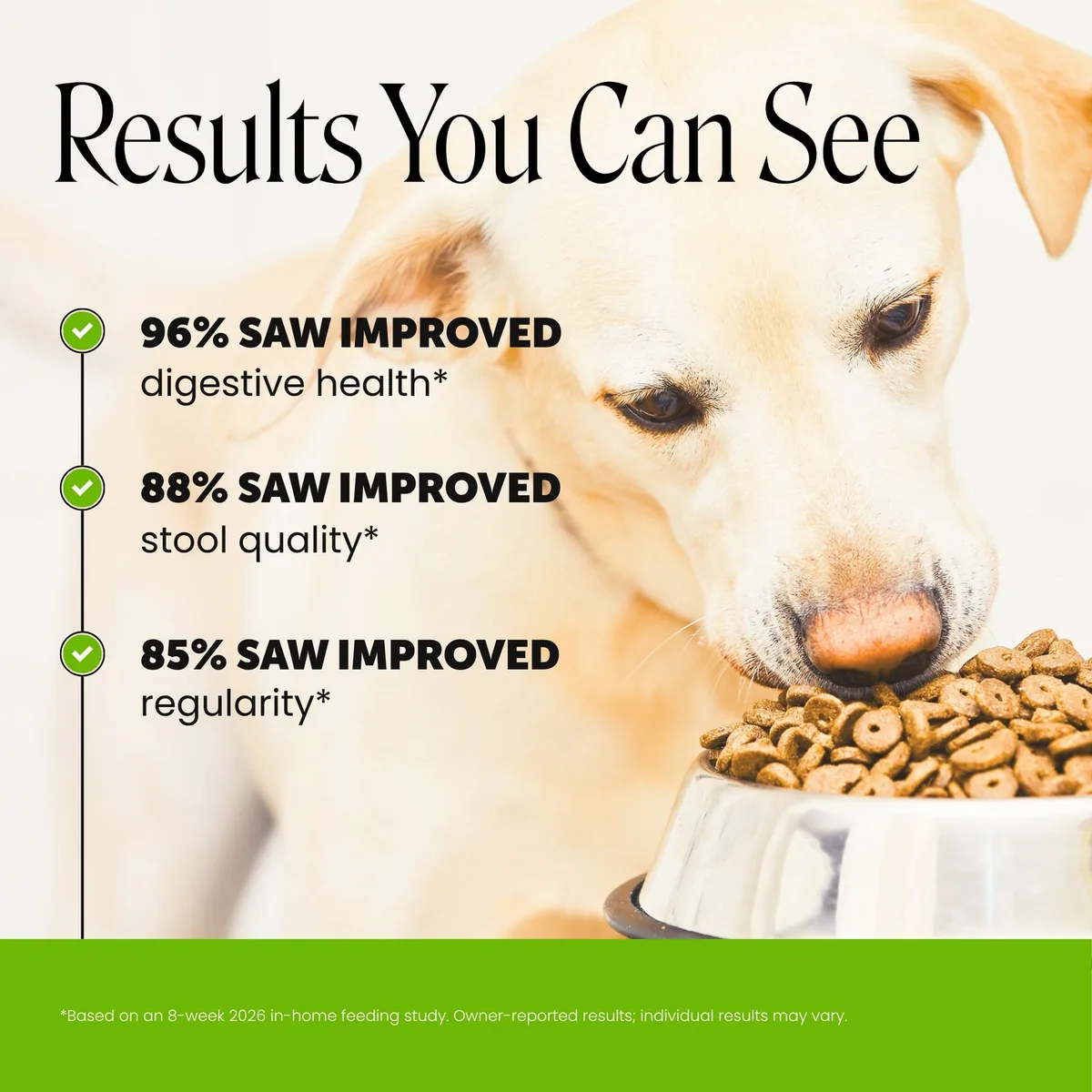
96% saw better digestion. The asterisk holds two more numbers, and eight weeks.
Pet Honesty's 2026 feeding study reported three results, not one. What each measured, what is in the chew, and how long a jar really lasts.
2026 in-home feeding study · owner-reported
digestive health96%
stool quality88%
regularity85%
The ad is one line long. 96% of dogs saw better digestion in two months. Then a small asterisk, and under it, in the size of type that exists to be skipped: based on a 2026 in-home feeding study conducted by Pet Honesty.
Most people read the 96 and stop. That is a shame, because the asterisk is the more useful half of the sentence. It tells you who ran the study, what kind of study it was, how long it lasted, and therefore what you should expect if you buy the jar and start on Monday.
So here is the whole thing, unpacked. Their numbers, their label, their dosing chart, and the arithmetic that follows from all three.
The asterisk, in full
What the footnote says
Based on an 8-week 2026 in-home feeding study. Owner-reported results; individual results may vary.
- Who ran it
- Pet Honesty, in house. Not an independent lab.
- Where
- In homes, on the dogs' normal food and normal routine.
- How long
- Eight weeks. The ad rounds that to two months.
- Who scored it
- The owners, by observation. No stool assay, no vet panel.
None of that is hidden. It is printed on the product page and repeated in the ad. But it changes how the number should be read, in both directions.
An in-home study is weaker than a placebo-controlled trial and nobody should pretend otherwise. Owners know their dog is on something. They want it to work. That bias is real and it inflates soft outcomes.
An in-home study is also closer to your actual situation than a lab is. The dogs stayed on their own food, in their own houses, with their own owners doing the feeding and the noticing. That is exactly the setting you are about to reproduce, right down to the person doing the scoring, which is you.
Three numbers, and the two that count
The study reported three things, not one. Ranked as published: 96% saw improved digestive health, 88% saw improved stool quality, 85% saw improved regularity.
Look at the order. The broadest, softest question scored highest. The two specific ones, the ones an owner can actually see in the yard, scored lower. That is what an honest owner-reported study normally looks like, and it is a small point in its favor. A survey where every number lands on the same triumphant figure is a survey that was not really asking.
It also tells you what to watch. "Better digestion" is a feeling. Stool quality and regularity are events, and they have dates. If you are going to run this for eight weeks, those are the two you should be writing down, because they are the two the study could actually measure.
The other number on the jar
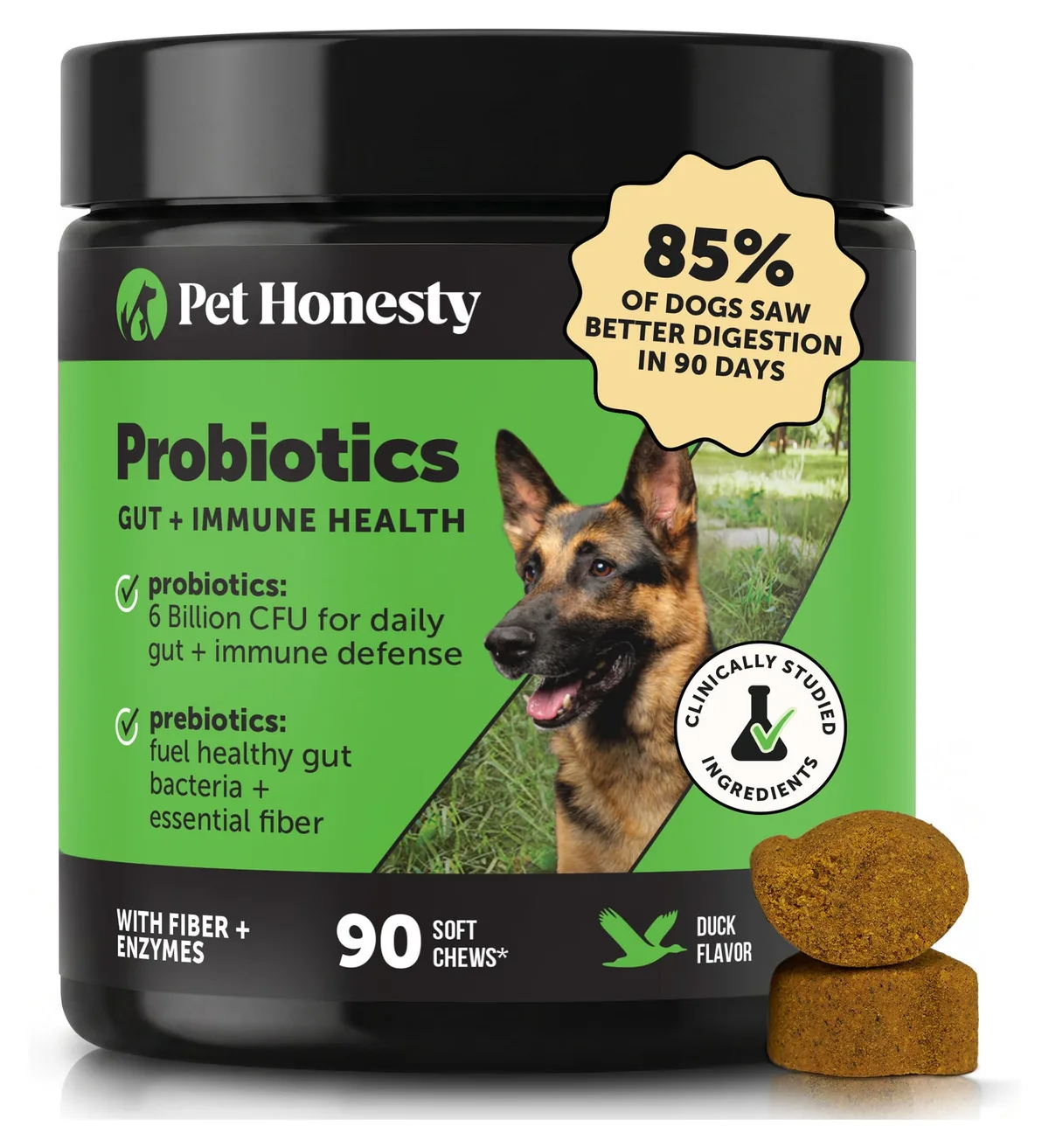
Look at the front of the tub and you will find a different figure: 85% of dogs saw better digestion in 90 days. That is not the study the ad cites. The ad points at the eight week work from 2026, whose three results are published further down the same page. Two different windows, two different studies. Worth keeping straight before you decide what "it should be working by now" means.
Eight weeks is not padding
The instinct with a digestive supplement is to judge it by Thursday. This one asks for eight weeks, and the interesting thing is where else that window turns up in Pet Honesty's own material, and where it does not.
4 weeks
Pet Honesty's calming claim is measured after four weeks of use, in an April 2023 survey. Behavior gets a short window.
6 weeks
Their Super Pooper claim, 93% of dogs with improved digestive health and better stools, is measured after six weeks of use, among dogs with sensitive stomachs, in a March 2023 study.
8 weeks
This study. Digestive health, stool quality, regularity, all read at the eight week mark in 2026.
6 to 8 weeks
And a customer, unprompted, on their own review page: "it took about 6-8 weeks but what a difference."
Nobody coordinated those. A 2023 study, a 2026 study and a woman writing about her own dog all land in the same six to eight week band, and every one of them is about the gut. The one claim that is not about the gut, the calming one, is measured at four weeks. When a company's own measurement windows and its own customers agree on a timescale, that timescale is probably real.
My pup started off with stomach issues when she was puppy. She was very picky about everything she ate and sometimes she won't eat at all. I tried everything. I ran across an ad for pet honestly and decided to give it a shot. Wow. . it took about 6-8 weeks but what a difference. Lee F., five stars, on the Pet Honesty product page
The practical consequence is not philosophical. It is a shopping decision, and it is the single most useful thing on this page: if you buy one jar and judge in two weeks, you have not run the experiment the number came from. You have run a different, shorter one, and then concluded from it.

What is actually in one chew
A probiotic chew can be almost anything. This is the part of a supplement where brands either put the numbers on the label or hide behind the words "proprietary blend". Pet Honesty prints the numbers. Here is the guaranteed analysis, transcribed from the tub.
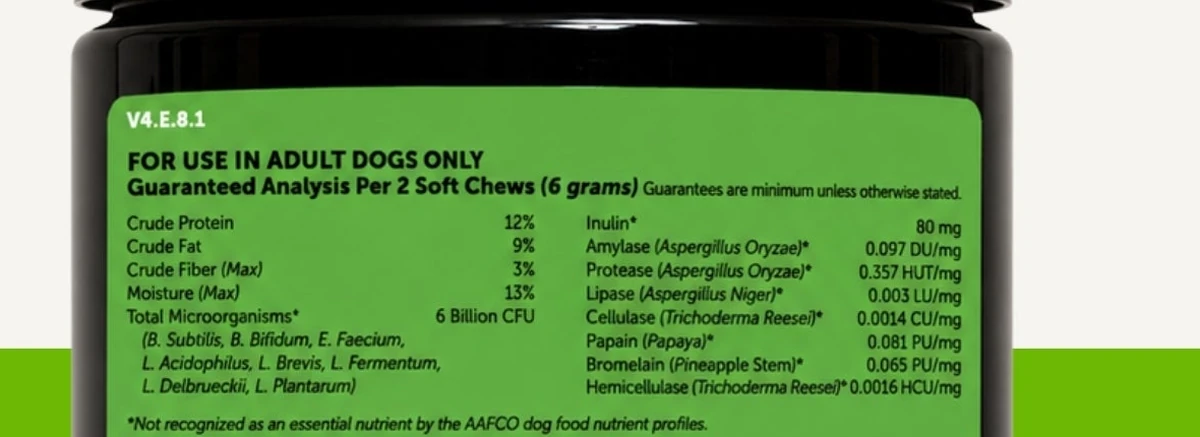
6
billion CFU per two chews, from eight named strains
80 mg
inulin, the prebiotic, sourced from dried chicory root
7
enzymes, each declared with its own activity unit
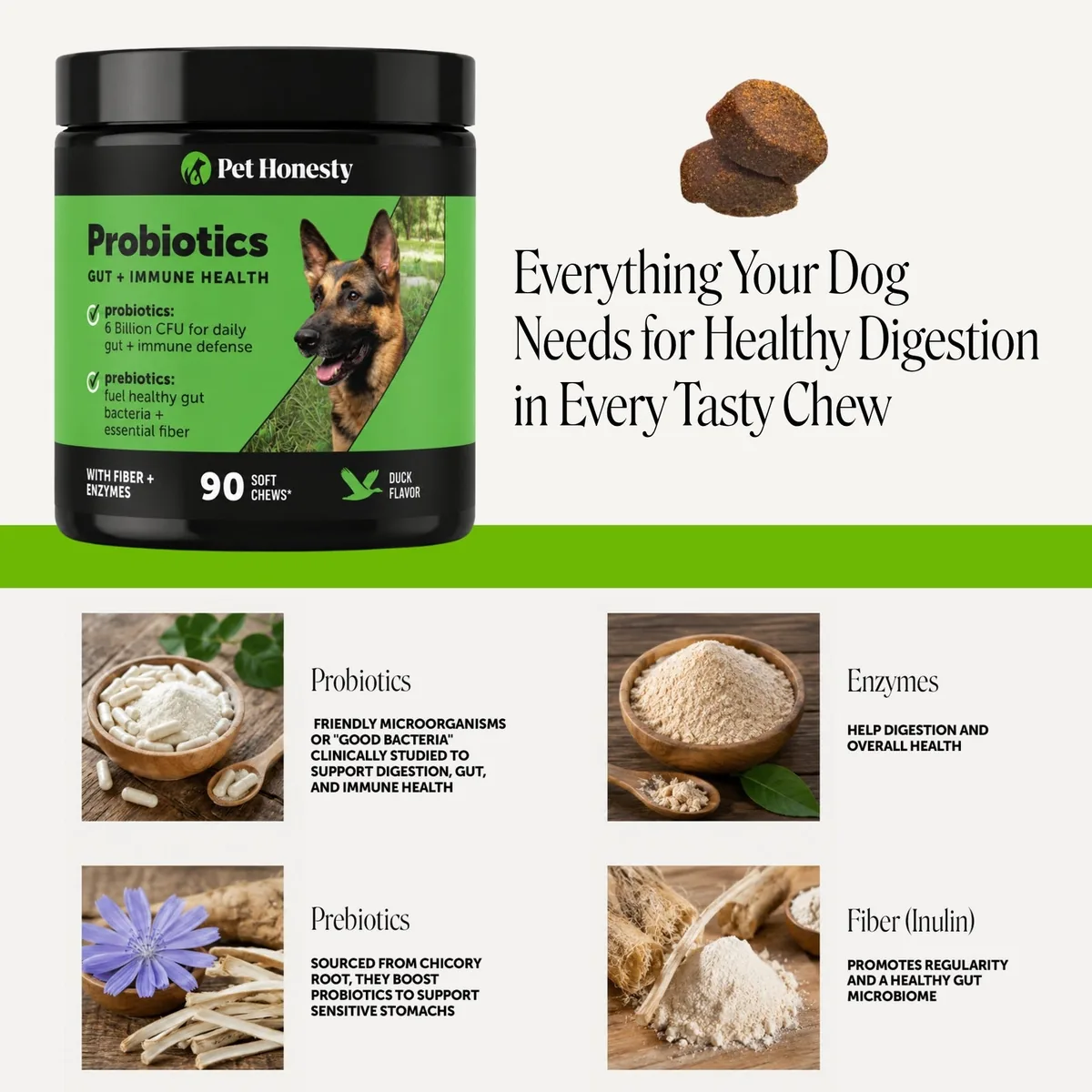
Three ingredient families, three different jobs. They are usually explained as one thing, which is why probiotic labels are confusing.
Eight strains, six billion CFU across two chews. Pet Honesty's own description of the job: help support the beneficial bacteria and microflora in a dog's gut, and address imbalances that can contribute to nutrient deficiencies, upset stomachs, loose stool and vomiting.
B. subtilis, B. bifidum, E. faecium, L. acidophilus, L. brevis, L. fermentum, L. delbrueckii, L. plantarum
80 mg of inulin, which the label traces to dried chicory root. A prebiotic is not a bacterium. It is what the bacteria eat, which is the reason a daily chew is a different proposition from a one-off dose.
Inulin, from dried chicory root
Seven of them, and they are the part of the panel almost everyone skips. Enzymes do not colonize anything. They break food down into pieces small enough to be absorbed, which is a separate mechanism from seeding a microbiome and works on a different clock.
Amylase, protease, lipase, cellulase, hemicellulase, papain, bromelain
| Enzyme | Source | Declared |
|---|---|---|
| Amylase | Aspergillus oryzae | 0.097 DU/mg |
| Protease | Aspergillus oryzae | 0.357 HUT/mg |
| Lipase | Aspergillus niger | 0.003 LU/mg |
| Cellulase | Trichoderma reesei | 0.0014 CU/mg |
| Hemicellulase | Trichoderma reesei | 0.0016 HCU/mg |
| Papain | Papaya | 0.081 PU/mg |
| Bromelain | Pineapple stem | 0.065 PU/mg |
Those activity units are not decoration. DU, HUT, LU, CU, HCU and PU are the standard measures for each enzyme class, and printing them means the manufacturer has to stand behind a level rather than a name. A label that says "digestive enzyme blend" and stops has told you nothing you can check.
One asterisk worth translating
Every one of those lines carries a small star, and the star says: not recognized as an essential nutrient by the AAFCO dog food nutrient profiles. That is not a warning. AAFCO defines what a complete dog food must contain, and probiotics, prebiotics and enzymes are not on that list. Anything declared outside the list has to be footnoted this way. It is a labeling rule, not a verdict.
The dose scales with the dog, and so does everything else
Here is where the arithmetic gets useful, and where most people buying a first jar get it wrong.
The guaranteed analysis is stated per two soft chews. The dosing chart says one chew daily per 25 pounds of body weight. Put the two together and the headline six billion CFU is not what most dogs are getting. It is what a fifty pound dog is getting.
| Dog | Chews per day | CFU per day | Chews over 8 weeks |
|---|---|---|---|
| 25 lb | 1 | 3 billion | 56, one jar covers it |
| 50 lb | 2 | 6 billion | 112, two jars |
| 75 lb | 3 | 9 billion | 168, two jars |
| 100 lb | 4 | 12 billion | 224, three jars |
Arithmetic on Pet Honesty's published figures: 6 billion CFU per 2 chews, 1 chew per 25 lb per day, 90 chews per jar, 56 days.
Read the last column again, because it is the honest version of the offer. An eight week run is one jar for a beagle and two for a labrador. If you buy one jar for a seventy pound dog and it runs out in a month, you did not finish the study. You stopped at the halfway mark and drew a conclusion.
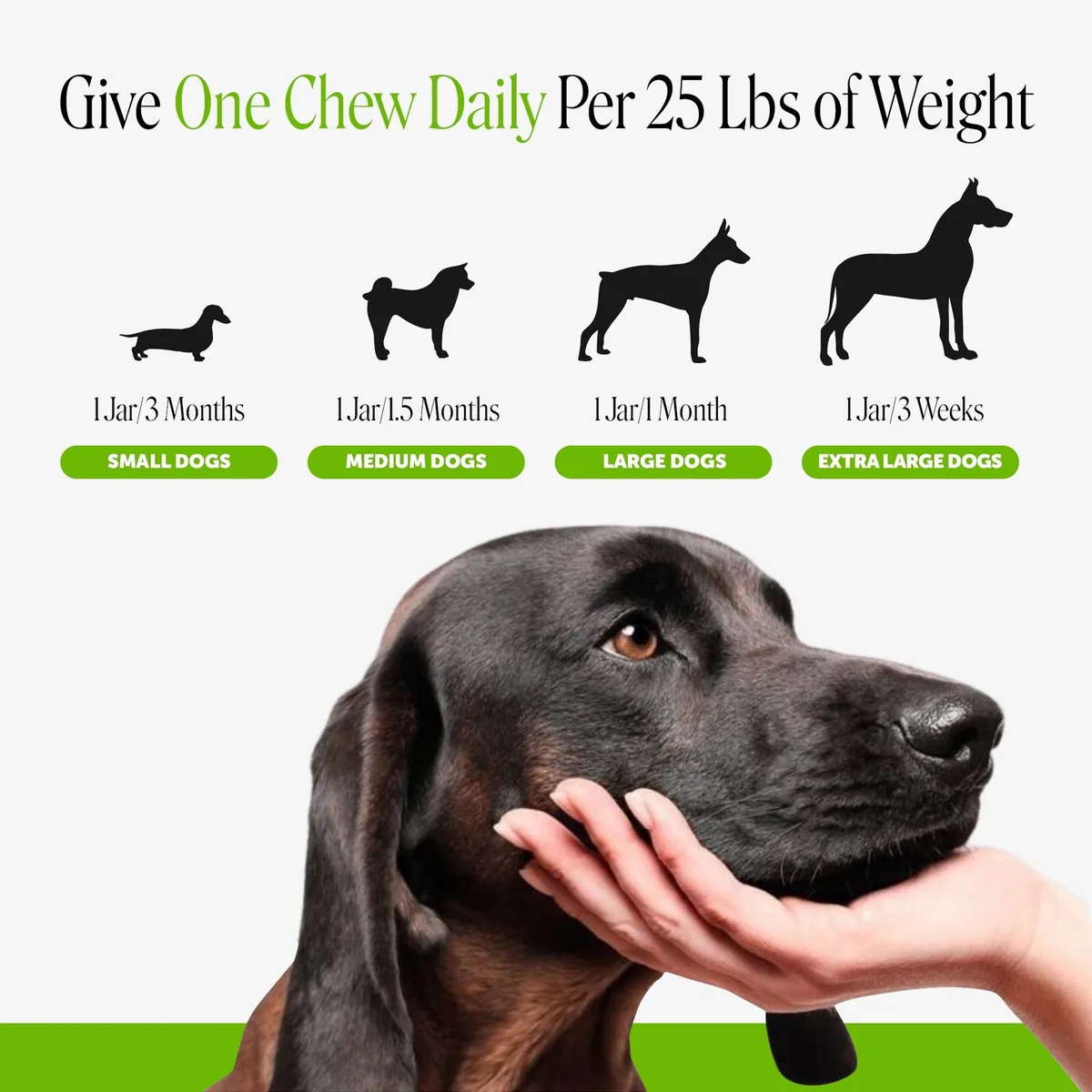
The same correction applies to the price. Pet Honesty's line is "as low as $0.29 a day", and the words doing the work are as low as. That is one chew. A jar is $32.99 for 90 chews, so a fifty pound dog on two a day is running at roughly double that, and gets through a jar in about six weeks.
Duck flavor, 90 soft chews, $32.99 on pethonesty.com
What owners actually write
The product carries a 4.8 out of 5 average from 758 reviews on Pet Honesty's own page. Averages are close to useless. The individual sentences are not, because they tell you which problem the thing solved.
Rated five out of five
My dogs are much better and have regular solid poops now
Shane M.
Rated five out of five
My lab really enjoys the duck flavor and I don't have to break the chews into her food anymore.
Melba B.
Rated four out of five
Our 15-year-old dog was having some issues with eating and overall health. We tried these and found she really likes the flavor, a bonus since she's gone off all of her favorites. She seems more comfortable after eating now and more willing to take her meds if she is aware this comes after.
Heather C., four stars
Notice how many of them are about the flavor. That reads as a soft point until you remember what an eight week protocol requires: fifty-six consecutive days of a dog voluntarily eating the thing. A supplement your dog spits out has an efficacy of zero, whatever the study says.
And the four percent
Ninety-six percent means four percent. Their own footnote says it plainly: individual results may vary. Here is one of those, published on their own product page, left up.
One hundred dogs, as the study reports them
96 saw improved digestive health4 did not
Rated two out of five
I saw a video on Tik Toc adn thought I would give this a try. It didn't work for my dog personally. He does have allergies and a yeast issue but he was recently diagnosed with hypothyroidism. I am thinking that maybe the reason this didn't work.
lorettapatterson60 P., two stars
That review is worth more than the five star ones, and not only because it is the honest counterweight. It names the reason. A dog with a diagnosed endocrine condition is not the dog the study recruited, and a gut supplement was never going to be the answer to it.
Which is the real filter here. These are chews for adult dogs with ordinary, unglamorous digestive trouble. Loose stool, an irregular schedule, a sensitive stomach, the aftermath of a food change. If your dog has a diagnosis, the vet comes first and this is at best a supporting cast member. The label says as much: for use in adult dogs only, intended for intermittent or supplemental feeding.
The short version
Five things to take away
- 01The 96% is Pet Honesty's own figure, from an eight week in-home feeding study run in 2026 and scored by owners. It is published with its footnote, which is more than most brands do.
- 02The same study reported 88% for stool quality and 85% for regularity. Those two are the ones you can verify yourself.
- 03The label is specific where it counts: six billion CFU per two chews across eight named strains, 80 mg of inulin, seven enzymes each with its activity unit.
- 04Dosing is one chew per 25 pounds daily, so a big dog needs two jars to finish eight weeks. Buy for the run, not for the jar.
- 05Judge it at week eight, on stools and regularity. That is the experiment the number came from.
Digestive Probiotic Chews, Duck
90 soft chews, $32.99. 4.8 out of 5 from 758 reviews.
Go to the product pageFussy dog? The same chew exists in pumpkin flavor. Stool quality specifically, rather than digestion in general? That is what Super Pooper Max Strength is built around, with 800 mg of fiber from six sources. The whole shelf sits in dog digestion.
Every figure above is quoted from pethonesty.com and from the ad's own footnote.